
Sealing Abandoned Houses Cut Fatal Overdoses 17.6% on Philadelphia Blocks
The overdose that kills someone is usually the one nobody sees. It happens behind a door that does not open, in a room with no one in it, on a stretch of city that has been quietly emptied out for years.
A new University of Pennsylvania study published Oct. 1 in JAMA Network Open puts a number on a hypothesis that has circulated among harm reduction workers for a long time: that the physical environment where people use drugs shapes whether an overdose becomes fatal. Led by Eugenia C. South, MD, MS, and Zachary Meisel, MD, MS, the research team examined 1,667 city blocks in one Philadelphia neighborhood with an unusually high overdose rate and compared what happened on blocks the city improved against blocks it did not.
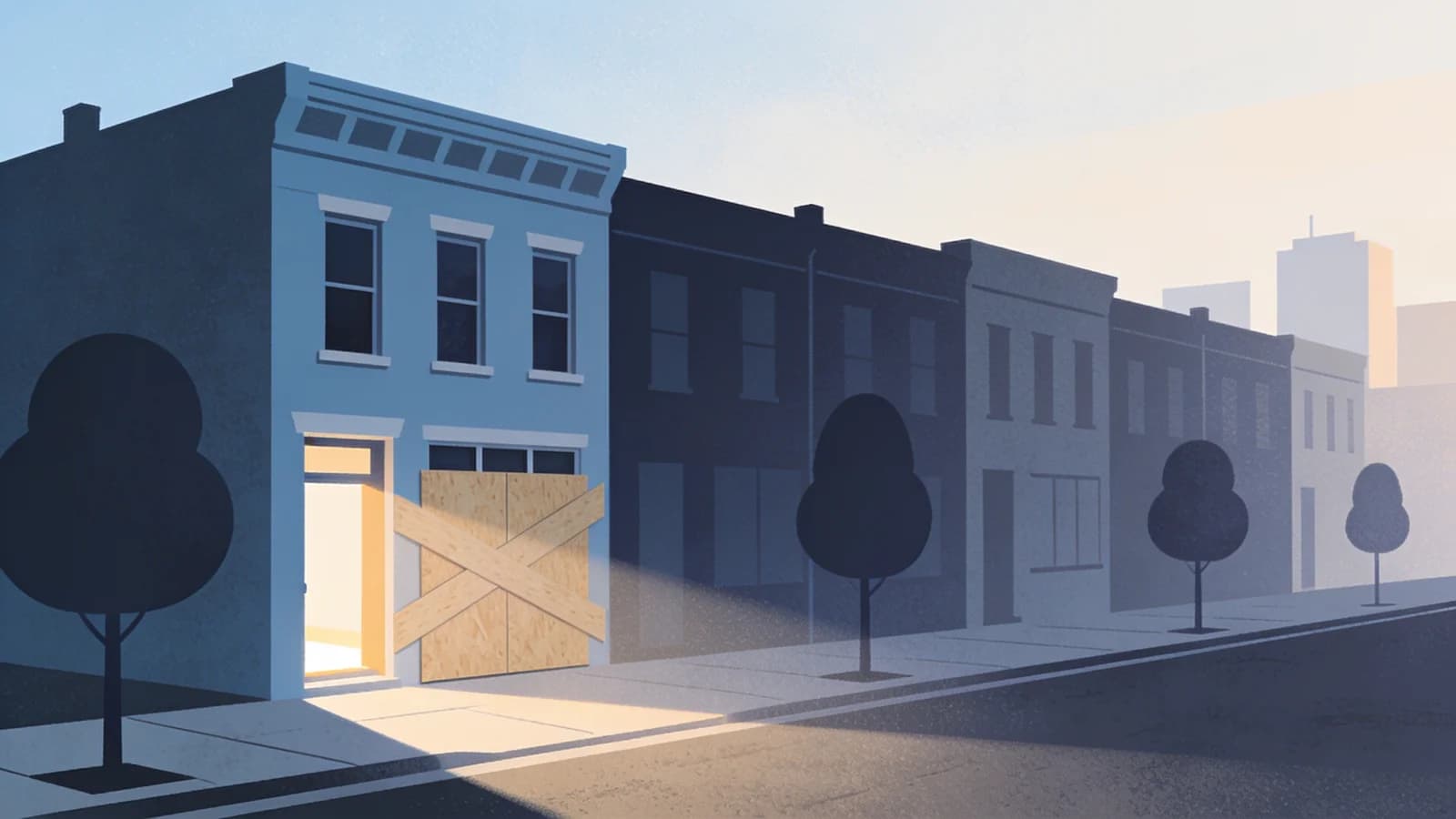
The headline finding is narrow and specific. Securing abandoned houses — mostly by sealing their doors and windows so people can no longer get inside — was associated with a 17.6% reduction in fatal overdoses and an 11.5% reduction in nonfatal overdoses on those blocks. Overall, the package of neighborhood improvements was linked to an estimated 35 fewer fatal opioid deaths during the three-year study window.
Not everything moved in the same direction, and that is the part of the paper worth reading closely.
What the Team Actually Measured
Between 2019 and 2021, Philadelphia carried out more than 2,100 improvements across those blocks: cleaning vacant lots, organizing community trash pickups, and sealing abandoned buildings. The researchers used a quasi-experimental design, comparing overdose trends on treated blocks with trends on untreated blocks in the same neighborhood, so that citywide shifts in drug supply or policy would not be mistaken for the effect of a sealed door.
What makes the study unusual is its outcome measure. Rather than relying only on death certificates, the team pulled Philadelphia Fire Department EMS data on overdose responses. That matters because it captures the nonfatal overdoses — the calls where someone still had a pulse when paramedics arrived — which are invisible in mortality statistics and which no single agency systematically tracks. Fatal and nonfatal overdoses do not always move together, and this study is a good illustration of why.
When the researchers looked at the interventions as a bundle, they found fewer fatal overdoses and no measurable change in nonfatal ones. The bundle average, in other words, hid two interventions pulling in opposite directions.
Sealing Buildings, Not Cleaning Lots
Disaggregated, the results split sharply.
| Intervention | Fatal overdoses | Nonfatal overdoses |
|---|---|---|
| Sealing abandoned houses | −17.6% | −11.5% |
| One-time vacant lot cleanup | no significant change | +11.7% |
| Community trash pickups | no significant change | no significant change |
The abandoned house result was the strongest signal in the paper and the only one that moved deaths and nonfatal events in the same, favorable direction. The vacant lot result was the opposite: a statistically notable increase in nonfatal overdoses on blocks that got a one-time cleanup, with no corresponding rise in deaths.
Why the Vacant Lots Went the Other Way
The researchers offer two explanations and are careful to call both of them hypotheses rather than findings. The first is maintenance. The lots in this study received a single cleanup, not the sustained greening-and-upkeep programs that South's earlier work on neighborhood remediation used. A lot cleaned once can deteriorate back toward its prior state within a season or two, leaving the intervention with little time to do anything.
The second is more uncomfortable. Clearing and opening a lot may make it a more usable space — but for drug use, not just for neighbors. That is not a claim the study can establish from administrative data. It is an admission that "clean up the neighborhood" is not a single intervention with a single direction of effect, and that the details of what is done and how long it is sustained appear to matter more than the general principle.
Trash pickups produced no detectable change in either direction, which is consistent with the idea that the operative mechanism is not blight in general but access to enclosed, unobserved space.
The Mechanism Nobody Proved
The paper's proposed explanation for the abandoned house finding is that sealing buildings changes where people use drugs rather than whether they use them. An abandoned rowhouse offers something the street does not: privacy, walls, and no one watching. Someone who overdoses alone in a sealed-off room is far less likely to be found in time for naloxone or a 911 call to matter.
If the building is no longer accessible, the reasoning goes, some of that drug use moves to places where other people are present — porches, sidewalks, stairwells, the corners where people already gather — and a bystander has a chance to intervene. That is a plausible story and consistent with what the data show, but the study design cannot distinguish it from other explanations. The authors say so explicitly. They did not measure where individual overdoses occurred, so the shift-in-location hypothesis remains an inference from the block-level result, not a demonstrated pathway.
Thirty-Five Deaths Is Both a Lot and Not Enough
It is worth sitting with the size of the effect. Thirty-five fewer deaths over three years across roughly 1,667 blocks is real. It is also a rounding error next to the national toll, and the intervention that produced it — boarding up windows and doors — is among the least expensive things a city can do. That combination is what makes the finding interesting to public health departments looking for tools that do not require new clinical capacity.
The honest caveats are significant. This was not a randomized experiment, so the paper can show an association, not causation. It covered a single Philadelphia neighborhood, which limits how well the results travel to cities with different housing stock, different drug supplies, and different patterns of where people use. And the study period, 2019 through 2021, spans the disruption of the early pandemic, when overdose patterns shifted nationwide in ways that are hard to fully separate from any local intervention.
Nor does sealing buildings help anyone who has nowhere else to go. Critics of blight remediation have long pointed out that making an encampment or a vacant building inaccessible displaces people without housing into worse conditions. The paper does not measure housing outcomes or where the displaced use moved to, and that is one of the more important gaps left for someone else to fill.
Where This Fits in Treatment
The researchers are explicit that their finding is not a substitute for clinical care. Sealing a building does not treat an opioid use disorder, does not put buprenorphine or methadone in anyone's hands, and does not replace naloxone. What it may do is keep someone alive long enough to reach opioid addiction treatment, which is the only intervention in this story that changes the underlying condition rather than the odds of surviving it.
Read that way, the study is really an argument about sequencing. Reversal drugs, medications for opioid use disorder, and accessible treatment are what bend the curve. Environmental remediation is a low-cost layer underneath them, one that operates on the minutes and seconds between an overdose and a rescue rather than on the disorder itself.
What Philadelphia Does With It
The city has already been moving in this direction. Boarding and securing vacant properties has been part of Philadelphia's blight strategy for years, driven more by concerns about crime, fire, and property values than by overdose. This study gives health officials a reason to coordinate with the agencies that seal buildings — and, more usefully, a reason to insist that vacant lot work be sustained and maintained rather than treated as a one-off photo opportunity.
The more transferable lesson may be methodological. By building an outcome measure out of EMS response data rather than death certificates alone, the Penn team produced results that could distinguish an intervention that saves lives from one that merely relocates risk. Most cities already hold that data. They simply have not been using it to ask whether the built environment is part of their overdose response or apart from it.
Sources
Editorial Board
LADC, LCPC, CASAC
The Rainier Rehab editorial team consists of licensed addiction counselors, healthcare journalists, and recovery advocates dedicated to providing accurate, evidence-based information about substance abuse treatment and rehabilitation.
Related Articles
Nearly Half of Outdoor Overdoses in One Florida County Happen Near Gas Stations, Study Finds
Mapping 1,661 non-fatal overdoses in Palm Beach County, FAU researchers found outdoor events cluster near gas stations and major transportation corridors.
Extreme Heat Amplifies Overdose Risk, Yale Study Finds
New research reveals that rising temperatures significantly increase overdose mortality, with each degree of heat index elevation contributing to approximately 150 excess deaths annually.

British Columbia Naloxone Program Prevented 78% of Overdose Deaths, Study Finds
Landmark Canadian study shows take-home naloxone kits prevented nearly 4 in 5 fatal overdoses from 2019-2024, offering evidence for harm reduction strategies