
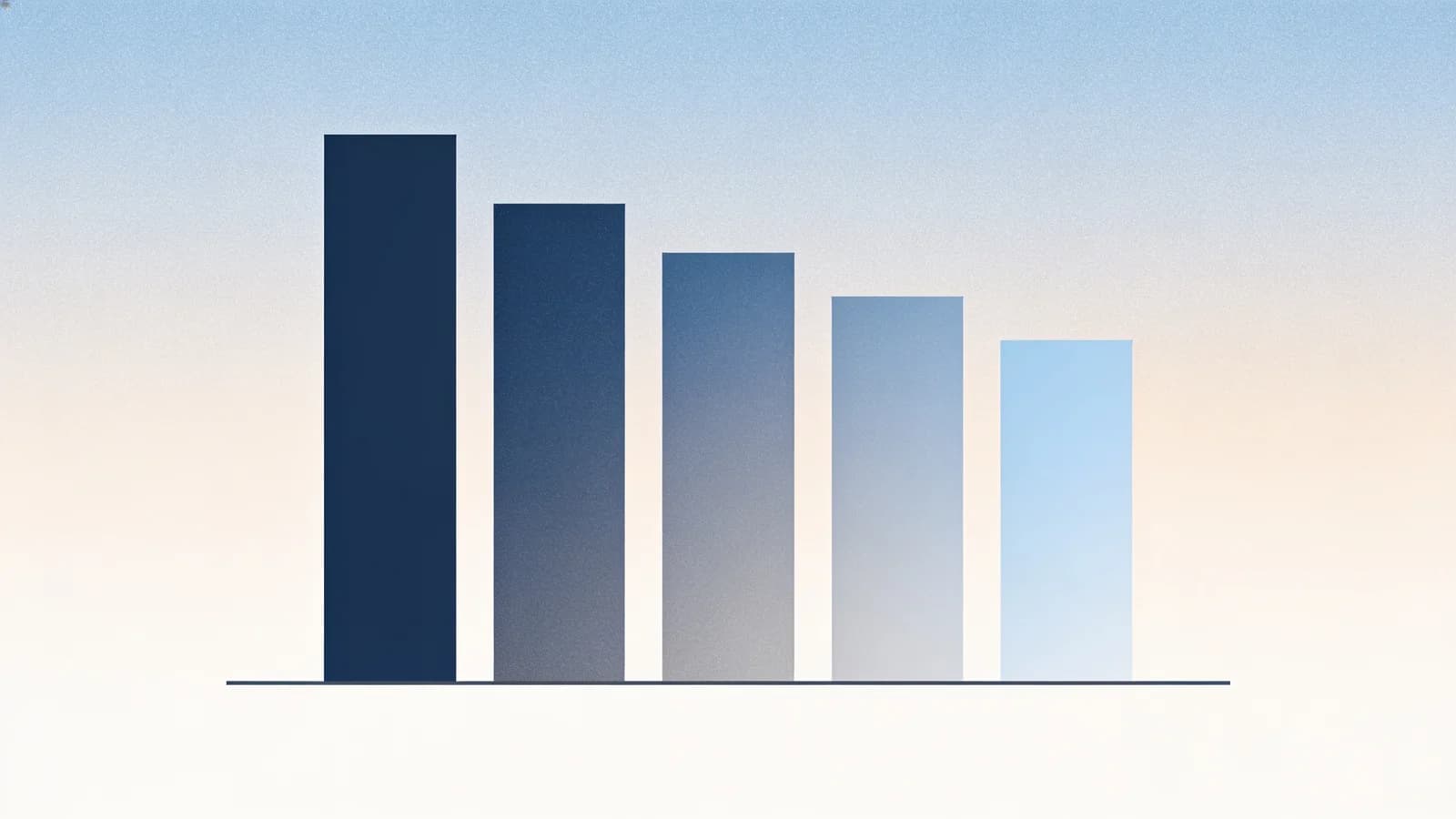
Seventy Percent of Patients Get Asked About Drinking. Four Percent of Heavy Drinkers Get Told to Cut Back.
Eighty-one percent of American adults saw a health care provider in the past year. Sixty-nine percent of them were asked about their drinking. Among the people who reported heavy alcohol use — the group a brief conversation is designed for — four percent were advised to cut back.
That gap is the spine of a new analysis of the screening, brief intervention and referral to treatment cascade published Oct. 24 in the journal Addiction. The authors, a team from RTI International with collaborators at the Alcohol Research Group, used three years of the National Survey on Drug Use and Health, pooling 2022 through 2024 into 139,532 adult respondents, and walked the cascade step by step: any health care use, then alcohol screening, then a brief intervention, then a referral, then treatment.
Each step loses people. The losses are not evenly distributed, and the shape of the drop is not what the cascade's designers assumed. The step that reaches almost everyone is the one that costs a clinic nothing. The step that changes behavior is the one that costs a clinician twelve minutes.
Where the cascade holds and where it tears
The numbers by severity
Screening is close to universal among people already sitting in an exam room, and it rises with severity in the direction you would want. Eighty-nine percent of adults with severe alcohol use disorder reported being asked about alcohol, along with 84 percent of those with moderate and 84 percent with mild disorder. Among adults who drink heavily but do not meet criteria for a disorder, roughly three in four were screened.
Then the intervention step arrives and the numbers separate. Thirty-three percent of people with severe disorder got a brief intervention. Seventeen percent of those with moderate disorder. Nine percent with mild. Four percent of heavy drinkers.
The referral and treatment steps track severity too, but from a low base: across the strata the study reports referral and treatment receipt in a range of roughly 3 to 23 percent. Even among people with a diagnosable disorder, the authors found that about 7.5 percent reported receiving any alcohol treatment in the previous year. The RTI release rounds the brief-intervention figure for heavy drinkers to 3.5 percent; the paper's own results section prints 4 percent, which is the usual rounding split between a weighted estimate and its presentation.
What a brief intervention actually is
The term sounds like a euphemism for a lecture. In the trials it is closer to a structured conversation: feedback on a screening score, a discussion of what the person's own drinking costs them, a negotiated goal, and a follow-up. The US Preventive Services Task Force gives screening plus brief behavioral counseling a Grade B recommendation for adults 18 and older, explicitly including pregnant women, and names the one- to three-item instruments — AUDIT-C and the single-question screen — as the most accurate options for adults.
The evidence for the counseling half is real but modest. The Cochrane review by Kaner and colleagues pooled 34 trials in its primary meta-analysis and found that people who received a brief intervention drank about 20 grams less per week a year later than controls, with smaller effects on the number of binge days. Twenty grams is roughly a drink and a half. That is not a cure. It is also, multiplied across the number of people who pass through primary care in a year, the difference between a population that is drifting toward disorder and one that is not.
Which is why the fourth step is the one worth measuring. Screening is an intake form. A brief intervention is a clinician deciding, in the middle of a fifteen-minute visit with three other problems on the list, to spend part of it on a substance the patient did not come in for.
The women's gap is not an access gap
Women were more likely than men to have used health care in the past year, by a marginal prevalence ratio of 1.112. They were about half as likely to receive a brief intervention, ratio 0.518. Among women with an alcohol use disorder, the odds of being referred to treatment were 0.621 relative to men, and the odds of receiving treatment were 0.788.
That pattern rules out the easy explanation. This is not a population that is absent from clinics; it is the population that fills them, particularly in reproductive and primary care, where a drinking question can feel like a question about pregnancy, about parenting, about judgment. The study measures the disparity without identifying the mechanism. What it establishes is that the setting where women are most likely to be seen is not the setting where they are most likely to be advised.
For a clinical reader, that is the actionable finding in the paper. Alcohol is the exposure behind roughly 178,000 deaths a year in the United States in 2020 and 2021, a 29 percent increase over 2016 and 2017 according to CDC's MMWR analysis, and the sex gap in intervention receipt sits directly across the pathway to alcohol use disorder treatment for half the adult population.
Race, age, and the second-order gap
Compared with White respondents, Black and Hispanic adults were less likely to be screened, and the disparity widened among people who reported heavy drinking. The paper's abstract prints the Hispanic screening ratio as 9.913, an obvious typographical error for 0.913, in a sentence where the Black ratio is 0.883 and every other measure in the model sits below 1. Hispanic respondents were also less likely to have used health care at all.
Adults 50 and older were less likely to be screened than younger adults, ratio 0.944. That is a smaller effect, but it points the wrong way against an epidemiology in which alcohol-attributable mortality has been rising fastest in middle-aged and older cohorts.
The authors examined insurance coverage as a covariate but the abstract does not report a coverage gradient, so the safest reading is the one the data supports directly: the gaps that show up are demographic and they persist inside the screened population, which means they are not purely a function of who has a card.
What the measurement can and cannot see
Everything here is self-reported, in a survey administered in person or by web with a household sample, and the cascade steps depend on respondents remembering a conversation. A patient who was told to cut back and does not want to hear it may report that nobody said anything. A clinic that delivers a two-minute scripted intervention may produce a patient who does not recognize it as one. Both errors push the intervention rate down, and neither is measurable from these data.
The design is cross-sectional, so the cascade is a snapshot of a single year's reported experience rather than a follow-up of the same people. It cannot say whether the four percent who got advice drank less afterward. It also cannot separate a clinician who chose not to raise the subject from a clinician who raised it and was rebuffed.
What it can say is where the process stops, at national scale, with margins of error small enough to make the pattern indisputable.
The part that is a delivery problem
Why the fourth step has no owner
Carolina Barbosa, a health economist at RTI and the paper's first author, put the practical case in the release: three out of four people who drink heavily are already being asked about their drinking, and fewer than one in twenty are advised to cut back, which she called a missed chance to act before a disorder develops. Katherine Karriker-Jaffe, a behavioral health expert at RTI and a senior author, framed screening as a first step that has been mistaken for the whole intervention.
The policy implication runs against the direction most health-system investments have taken. Screening is cheap and billable in a bundle. Advice is neither. An electronic health record can force a screening question into a workflow; it cannot force the conversation that follows the positive screen, and clinics are not paid separately for having it. The result is a cascade that looks complete on a dashboard — most patients screened, most screens documented — and empties out precisely at the step where anything happens.
The authors also argue for moving the intervention outside the exam room entirely, toward community settings where people who do not have a usual source of care can be reached. That is a different delivery model, and it is the one that matches where the untreated population actually lives.
For families watching someone move from heavy drinking into disorder, the cascade explains a familiar experience: the questions were asked, repeatedly, at annual physicals and urgent care visits and pre-operative clearances, and nobody ever said the sentence that might have changed the trajectory. The study suggests that the sentence is rarer than the asking by a factor of seventeen. Brief interventions are also only one route — structured cognitive behavioral therapy carries stronger evidence for people who have already crossed into disorder, and the cascade's own treatment step, at 7.5 percent, is the measure of how few arrive there.
Four percent is not a rounding error in a national survey. It is a description of what American medicine currently does when it finds heavy drinking in a patient: it writes it down.
Sources
- Barbosa C, Dowd W, Rodriguez Borja I, Blakey SM, Delk J, Cance JD, Mulia N, Karriker-Jaffe KJ. Alcohol use screening, brief intervention and referral to treatment cascade of care in the USA: Variation by alcohol use and socio-demographic characteristics. Addiction (DOI 10.1111/add.70683), published Oct. 24, 2026; PMID 42920323
- RTI International — Screening isn't enough: Study finds few adults who drink heavily receive interventions (Oct. 30, 2026)
- US Preventive Services Task Force — Unhealthy Alcohol Use in Adolescents and Adults: Screening and Behavioral Counseling Interventions (final recommendation statement, Grade B)
- Kaner EFS, Beyer FR, Muirhead C, et al. Effectiveness of brief alcohol interventions in primary care populations. Cochrane Database of Systematic Reviews (DOI 10.1002/14651858.CD004148.pub4), 2018
- CDC — Deaths from Excessive Alcohol Use, United States, 2016–2021. MMWR 73(8)
Editorial Board
LADC, LCPC, CASAC
The Rainier Rehab editorial team consists of licensed addiction counselors, healthcare journalists, and recovery advocates dedicated to providing accurate, evidence-based information about substance abuse treatment and rehabilitation.
Related Articles
A First Month Above 50 MME Raised OUD Risk 147 Percent. Gabapentin Landed at 102.
Among 399,500 Medicaid patients starting low back pain care, a first month above 50 MME was tied to 147% higher odds of opioid use disorder or overdose — and gabapentinoids to 102%.
Drug-Linked Heart Infections Fell 18 Percent. Stimulants Now Drive Nearly Half of Them.
A national study of 118,190 hospitalizations finds drug use-associated endocarditis declining since 2020, while stimulants' share climbed from 37 to 47 percent.

A Third of Overdose Hospitalizations Come With Kidney Injury. Two-Thirds of Those Are Severe.
New CDC data covering 1.3 million overdose hospitalizations finds acute kidney injury in 34.5 percent of them — and the sickest group is the youngest.