
A Patch That Senses Fentanyl Through the Skin and Releases Its Own Antidote
The single most repeated piece of advice in harm reduction is also the hardest one to follow. Don't use alone. In practice, using alone is often the point — a private act, conducted in private, by people who have learned that witnesses carry risks of their own. Cynthia Haley has watched what that arithmetic costs. "It is not uncommon for somebody that does overdose, if they are alone, to not come back from that," said Haley, a registered peer recovery specialist supervisor with the Bradley Free Clinic's Hope Initiative in Roanoke.
A laboratory in Blacksburg thinks it can put a safety net on a patch smaller than a penny.
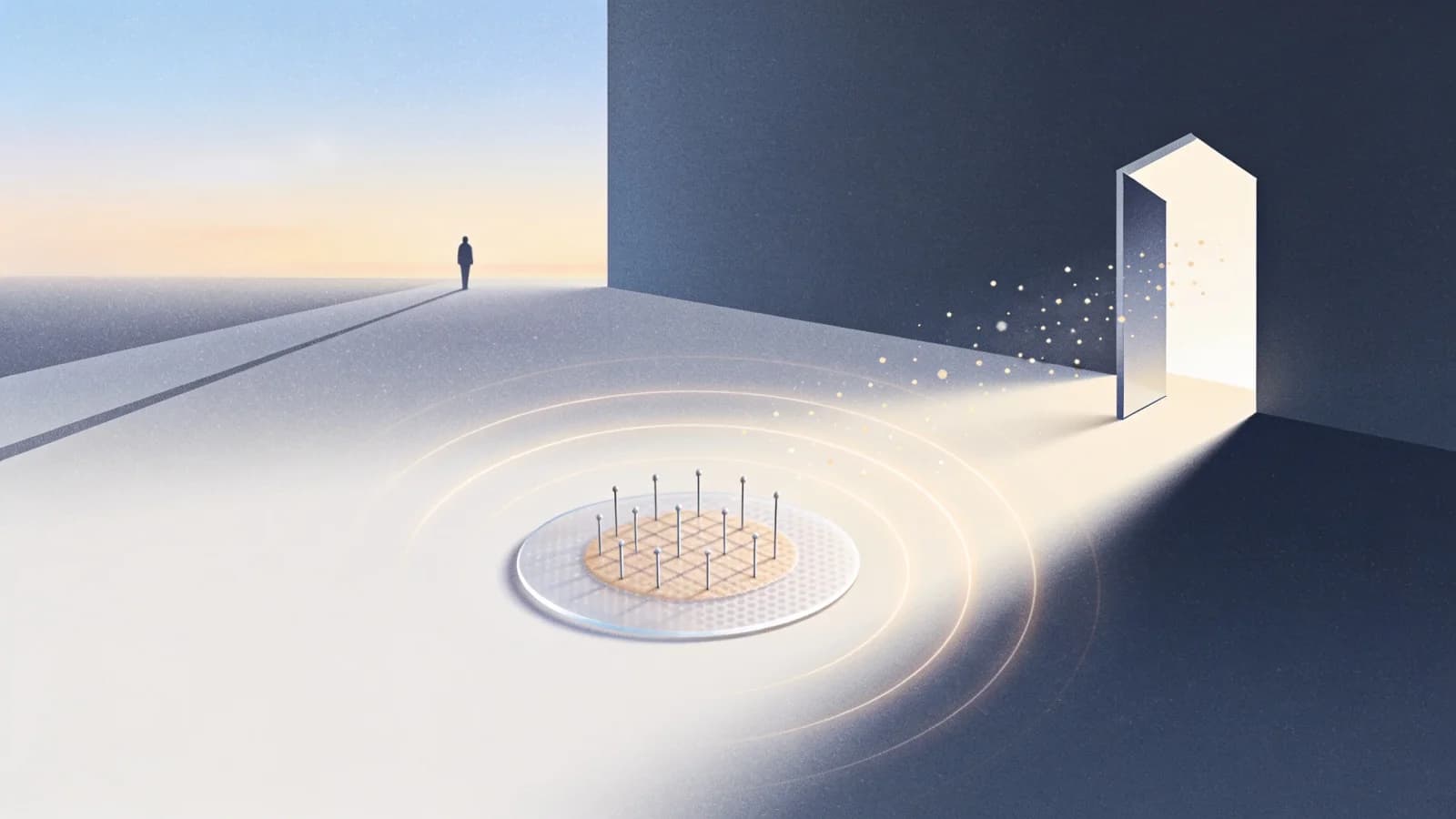
Wujin Sun, whose lab sits in Virginia Tech's department of biological systems engineering, is developing what his team calls the iNal patch: a device that detects an overdose-level concentration of fentanyl in the fluid just beneath the skin and then releases naloxone on its own, without a bystander, a phone call, or a battery. The work was described in Advanced Science under the title "A Fentanyl-Responsive Microneedle Patch for Harm Reduction," led by visiting instructor Penghui Zhao, and reached a wider audience this week through reporting by Cardinal News' Tad Dickens.
It is not a product. It is a mouse study with a patent application and a funding gap in front of it. But the approach occupies a space no approved overdose intervention currently fills.
The Problem the Patch Is Built For
The paper opens with a familiar ledger: more than 107,000 overdose deaths in the United States in 2022, with synthetic opioids including fentanyl responsible for roughly nine in ten of them. Programs built over the past decade have chipped at that number — naloxone distribution, drug-checking, and treatment access on the clinical side — but each assumes a person still able to act, or someone nearby willing to.
Sun's framing of the gap is blunt. "A lot of overdose-caused deaths are for people who live alone," he said in a video conference interview in August, before the article was published. "If they can be helped immediately, basically their lives can be saved. Our device is trying to eliminate the need of someone nearby."
That last clause is doing a lot of work. Reversing an opioid overdose normally requires an initiation: someone notices slowed or stopped breathing, retrieves naloxone, administers it, calls for help, and often administers a second and third dose. Remove the person who does those things and the pharmacology has nothing to work with. For a reader weighing opioid addiction treatment options for themselves or someone else, the patch would be a floor beneath the treatment ladder rather than a rung on it — something that only matters in the minutes when a person cannot act.
Gates, Not Batteries
The iNal patch borrows its architecture from a class of drug-delivery research that has matured over the past decade in cancer and diabetes work. Each patch carries 121 microscopic needles, small enough that the team describes tissue damage as negligible. The needles aren't hollow syringes; they access interstitial fluid, the thin layer of liquid between cells, which is where the patch does its sensing.
Beneath the needles sits a reservoir of porous silica nanoparticles loaded with naloxone. The particles' openings are capped by molecular gates — aptamers, short strands of nucleic acid engineered to bind specific molecules. The aptamers on this device bind fentanyl. When interstitial fentanyl reaches the concentration that accompanies overdose, the gates change shape, the caps open, and naloxone moves into the skin.
Because the release depends on how much fentanyl the aptamers encounter, the dose scales. More drug opens more gates.
Sun is explicit that the design choice was as much about what to leave out as what to include. Other research groups have demonstrated naloxone-delivering patches, but, he said, "those need batteries." The iNal patch is entirely passive. "Our design is totally different. We don't need power supplies. Everything is environmentally friendly and safe."
Why Renarcotization Matters
The paper's specific claim about sustained release targets a phenomenon familiar to paramedics and emergency physicians: renarcotization. Fentanyl, particularly in the quantities present in the illicit supply, outlasts a single dose of naloxone. The naloxone wears off, the opioid does not, and the patient slides back into respiratory depression after the apparent rescue.
The iNal patch's silica reservoir is designed to keep releasing naloxone for roughly 24 hours after it detects the drug, which the authors describe as "a sustained defense against renarcotization." Whether a transdermal patch could deliver naloxone fast enough to matter in an acute overdose — intramuscular and intranasal routes work in minutes — is a question the mouse data gesture at more than settle, and the human question is further away still.
What the Mice Showed
The team's animal work, reported in the July paper, is the basis for the claim that the patch detects and responds. That is a proof of mechanism, not a proof of clinical utility. Nothing in the published work yet establishes that a human wearing the patch would absorb an adequate dose through skin during an actual overdose, or that the trigger threshold corresponds to the point at which intervention is still early enough.
Those are ordinary hurdles for a delivery platform in its first published iteration, and they are the reason the timeline is what it is.
Four Years, Minimum
Sun's own estimate is that human use is at least four years away, contingent on Food and Drug Administration clearance. The patent has been filed through the university. The team is pursuing grant funding and investors, which is the stage where university medical devices either become companies or become citations.
The path from mouse to market for a novel overdose intervention would run through a first-in-human safety study, dose-finding, and eventually a trial large enough to show benefit in a population that is difficult to enroll and to follow. Naloxone itself is a decades-old, off-patent molecule; a device that administers it is a different regulatory object than the drug, and the FDA has no established template for a passively triggered transdermal overdose rescue product.
For now, the honest description is what Cardinal News reported: a device tested in mice, with use in humans at least four years away.
The Skeptic in Roanoke
The most useful passage in that reporting comes from Haley, who has spent years in rooms with people in active use rather than in the literature about them. She sees the appeal immediately, and also the friction.
Her concerns track the way people who use drugs actually think about surveillance. Existing programs already ask for something uncomfortable — a call-in hotline where a user provides an address and a volunteer alerts emergency medical services if the caller stops responding. "However some people, especially when they're really caught up in the grips of addiction, don't always trust that concept, giving their location," Haley said. "They think maybe that could be some type of setup for law enforcement."
She described a recent conversation with a group of people in active addiction about the patch. Their questions were practical and specific: how would a wearer know what level triggered it, and what if it fired too early? "If it were to kick in too soon and take away their high," she said, "especially if they had spent so much time and energy trying to get the money to get high, to avoid feeling sick."
That objection is not a flaw in the device so much as a description of the situation the device is meant to improve. Anyone building an autonomous rescue system has to accept that its threshold will be perceived by some users as a loss, not a gift — and that acceptance is what determines whether it ever gets worn.
A Platform, Not Just a Patch
Sun's larger ambition is visible in his description of the underlying technology. The aptamer-gated nanoparticle approach isn't specific to fentanyl. "Many diseases can be treated this way," he said. "For example, diabetes — if we sense a peak in blood glucose levels, we can release insulin. Or if there are other metabolic diseases that have a specific signal, we can monitor and release the drug immediately."
Opioids are structurally similar to one another, which means the same architecture could plausibly be retargeted to other opioids and to emerging synthetic classes. That generality is attractive to funders, and it is also why the overdose application may be judged on the strength of the whole platform rather than on its own.
What the Patch Doesn't Replace
Naloxone delivered by a bystander remains cheaper, faster, and available today. Drug-checking services can tell a person what is actually in the supply before they use it, which a patch cannot. And nothing in this research addresses why the overdose happened — the medication-assisted treatment that keeps people alive across months and years, the housing and behavioral health capacity that keep them stable, or the possibility that a person simply stops using.
Sun's device, if it ever reaches the market, would be a last line rather than a first one. It would sit underneath all of that, waiting in the minutes when no one is there.
Haley's own reaction to the project was, on balance, hopeful. She noted that one of her conversations with the team happened on Aug. 31, International Overdose Awareness Day, and that National Recovery Month began the next day. "During this time of year, we're always reminded of the lives lost to overdose and the impact that that has had on our communities," she said. "So it's encouraging to know that Virginia Tech and other institutions are working toward innovative approaches to reduce the likelihood of a fatal overdose or prevent it."
The patch will not be the thing that ends the epidemic. It might be the thing that buys ten minutes for one person on one night when nobody else is coming.
Sources
Editorial Board
LADC, LCPC, CASAC
The Rainier Rehab editorial team consists of licensed addiction counselors, healthcare journalists, and recovery advocates dedicated to providing accurate, evidence-based information about substance abuse treatment and rehabilitation.
Related Articles
Orphines and Cychlorphine: The Next Wave of Synthetic Opioids Threatening to Reverse Overdose Declines
As overdose deaths finally begin to fall, a new class of ultra-potent synthetic opioids is emerging in the US drug supply, presenting unprecedented challenges for detection and treatment.
Gabapentin Linked to Rising Overdose Deaths as 90% of Cases Involve Opioids
CDC study reveals gabapentin detection in overdose deaths increased significantly, with 85-90% of cases also involving opioids

Sealing Abandoned Houses Cut Fatal Overdoses 17.6% on Philadelphia Blocks
A Penn study of 1,667 Philadelphia blocks found sealing abandoned rowhouses was tied to a 17.6% drop in fatal overdoses — while one-time vacant lot cleanups went the other way.