
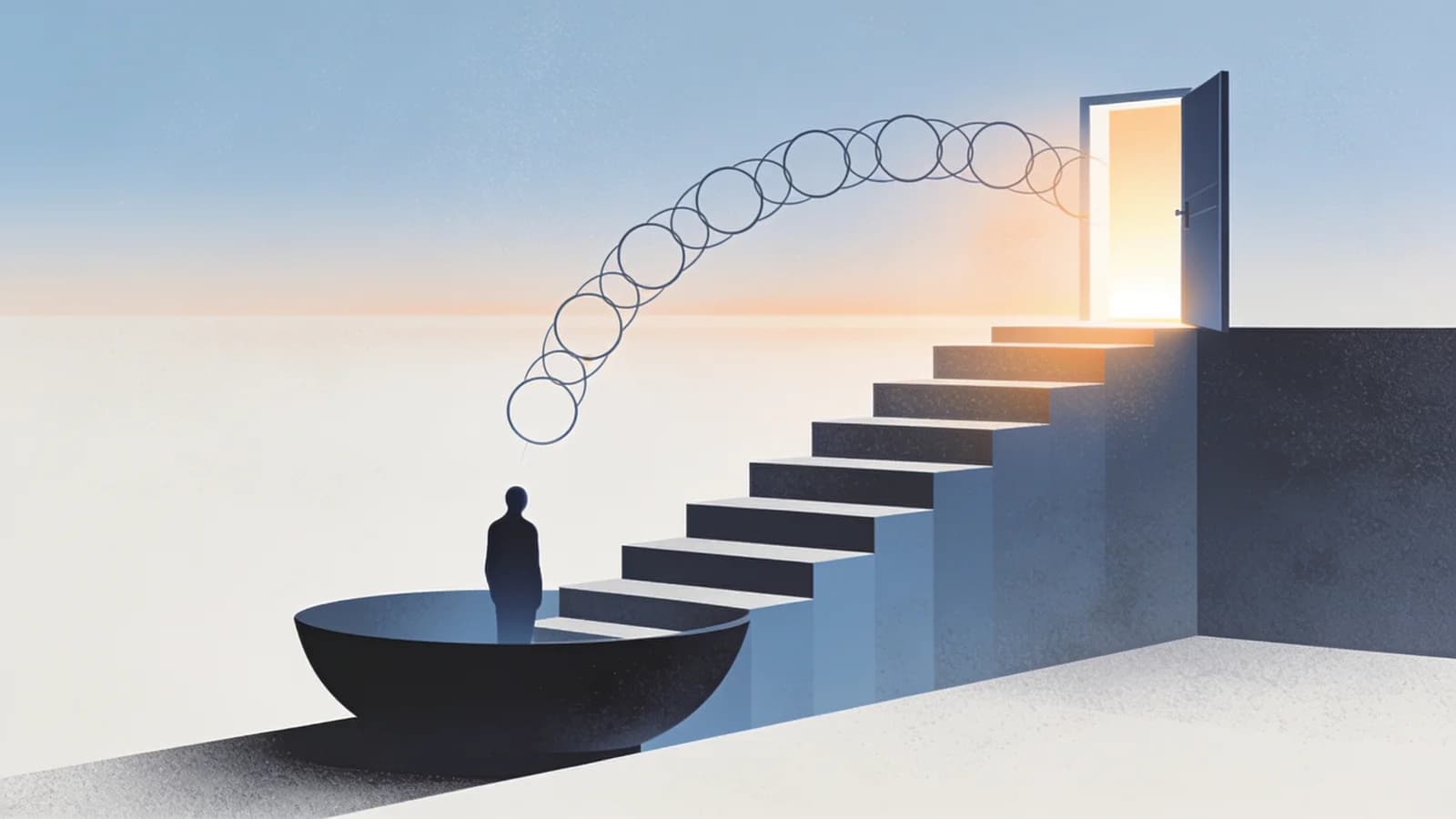
Most People Who Hit "Rock Bottom" Say It Didn't Move Them to Recover
The advice arrives in almost every family that has watched someone disappear into opioids: stop helping, let them hit bottom, and the crash will do what love could not. It is offered as hard-won wisdom, the same story that runs through recovery memoirs, twelve-step rooms, and television arcs. It has rarely been tested against what people in recovery actually say about their own turning points.
A small qualitative study from the Johns Hopkins University School of Medicine, published October 6 in the Journal of General Internal Medicine, takes that advice seriously enough to check it. The conclusion is uncomfortable for anyone who has ever repeated it. Rock bottom, the authors find, is real, common, and mostly inert. What it produces is not motivation. It is more loss.
Twenty interviews and one inherited assumption
The research team — Shiv Ayappa, Divya Manikandan, Katharine Press Callahan, Travis N. Rieder, Michael Fingerhood, and Margaret S. Chisolm — conducted semi-structured interviews with 20 people in recovery from opioid use disorder. The interviews were built around a specific question: did you experience a rock bottom, what was it like, and did it push you toward recovery?
Two team members independently coded every transcript using inductive thematic analysis, working through disagreements by discussion until a shared codebook emerged. The method matters here. Inductive coding is designed to let categories surface from what participants said rather than confirming a framework the researchers brought with them — and the framework under examination was the culture's, not theirs.
Seventy percent hit bottom. Two were moved by it.
Fourteen of the twenty participants, or 70%, reported an experience they would call rock bottom. Only two — 10% — said that experience actually motivated them toward recovery. The remaining eighteen described something else as the hinge: what the authors call turning points, which 85% of participants identified as the real catalyst.
That gap is the study's headline. The overwhelming majority of people who reached the kind of devastation the culture treats as a springboard found no spring in it. Had the researchers interviewed people who never entered recovery, or who died before they could, the ratio would likely look worse still — the sample is, by design, the survivors.
What a rock bottom is made of
The four themes that recurred across the interviews were remarkably consistent. Participants described the loss of social connection — isolation from family and friends, the sense of becoming a person others had given up on. They described character erosion, a moral identity coming apart. They described the exhaustion of resources, financial and material. And most severely, they described the loss of the will to live.
None of those are ingredients of motivation. They are the ingredients of a person with fewer reasons to keep going, which is precisely the opposite of what the idea of rock bottom promises. As the authors put it, participants arrived at a state in which life no longer felt worth living — not a threshold from which change becomes easy.
What actually turned people
The turning points participants named were specific and, notably, external to the collapse itself. Parenthood recurred. So did near-death experiences and incarceration. Each shares a feature that rock bottom alone lacks: something on the other side of survival worth moving toward.
Parenthood, jail, and a body that nearly quit
A child is a reason to stay well, not merely a reason to stop. A jail cell supplies structure, forced abstinence, and a scheduled future — crude, but external. A near-death experience is the hardest to romanticize: it is a confrontation with mortality that only becomes motivating when the person survives into a life they want to keep. What these turning points have in common is not their severity. It is that they carry a future. Rock bottom, stripped of that, carries only a past.
The distinction is the direction of the causal arrow. Crisis does not generate change by itself. Change appears when crisis meets hope, connection, and a plausible future — when the person can see something to stay sober for. Degradation without that is not a floor. It is a downward slope.
For families and clinicians who have internalized the "let them hit bottom" instinct, the finding removes the empirical cover. The authors note that the idea may be actively stigmatizing, framing a person with addiction as someone who must be broken before they can be repaired, and that waiting for an imaginary floor can delay care by months or years. In a period when opioid use disorder remains a defining public health crisis and the treatment workforce is already short, that wait is a cost the system cannot absorb.
The opposite of collapse
The study's most interesting move is conceptual. The four themes of rock bottom — lost connection, eroded character, lost resources, lost will to live — map almost exactly onto the domains that flourishing researchers use to describe a life going well. The Harvard-based Global Flourishing Study and related work by Tyler VanderWeele describe those domains as close relationships, character and virtue, material stability, and a sense of meaning and purpose.
Read that way, rock bottom is not a mysterious psychological event that happens to some people. It is the systematic demolition of the things that make a life livable. Which reframes the clinical question entirely: not "how bad must it get?" but "what does this person need in order to build a life worth staying in?"
The factors participants described as critical to sustaining recovery point the same direction. Two themes dominated: rebuilding social connection and character growth. People who stayed well talked about reweaving relationships and repairing their sense of who they were. That aligns with a decade of research on recovery capital — the internal and external resources a person can draw on to start and maintain recovery — and with qualitative work showing that people who recover typically describe a shift in identity rather than a single moment of surrender.
For people navigating opioid use disorder themselves, that shift in emphasis is practical. It suggests the work is less about bottoming out and more about accumulating the relationships, roles, and reasons that make continued use costly in a way that feels chosen rather than imposed.
The limits of twenty people
The study is honest about its own boundaries. Twenty participants, all currently in recovery, cannot stand in for everyone with opioid use disorder — not for the people who are still using, and not for the people who died before recovery was ever a possibility. Qualitative thematic analysis is interpretive by nature, however carefully dual-coded. The study design also means the researchers are describing how recovery looks in hindsight, which shapes how people narrate their own histories.
The authors are careful not to claim that crisis is irrelevant. Near-death experiences were among the most commonly cited turning points, and a separate literature on "hitting bottom" in alcohol use disorder exists precisely because people do describe such moments as pivotal. The claim is narrower and more defensible: crisis does not do the work on its own.
What this means for treatment
The findings do not overturn treatment as usual; they argue for starting it earlier and aiming it differently. If recovery begins with a glimpse of a flourishing life rather than with a collapse, then the clinical tasks are relational and cumulative — the slow rebuilding of connection, purpose, and self-respect that integrated mental health and substance use care is designed to provide. Medication remains central to managing opioid use disorder, but medication without a life to return to is a bridge with nothing on the far side.
The study's practical instruction is a reversal of the folk one. Rather than telling families to step back until the crash arrives, it suggests they should work to strengthen, early and persistently, the exact things addiction destroys: relationships, character, resources, and hope. The mythology of the bottom has survived because it gives bystanders a reason to do nothing. Twenty interviews say that reason was never a good one.
Sources
Editorial Board
LADC, LCPC, CASAC
The Rainier Rehab editorial team consists of licensed addiction counselors, healthcare journalists, and recovery advocates dedicated to providing accurate, evidence-based information about substance abuse treatment and rehabilitation.
Related Articles

ASU Study Finds Opioid Withdrawal Suppresses Brain's Myelin-Building Genes
Arizona State University researchers find opioid withdrawal suppresses two myelin-regulating genes in the prefrontal cortex, pointing to a new treatment target.

Arkansas Health Providers Confront Youth Substance Use Crisis at UAMS Summit
University of Arkansas Medical Sciences convenes statewide summit as data reveals 60% of adolescents in substance use treatment have co-occurring mental illness.
Nearly One-Third of Teens With Cannabis Use Disorder Face Treatment Delays, Study Finds
Research published in the American Journal of Preventive Medicine reveals rising barriers to timely care for adolescents with cannabis use disorder, with younger teens and males most affected.