
A Pilot Put an EEG Rig in an Addiction Clinic. Making Music Moved One Brain Signal.
Music therapy has been an accepted adjunct in addiction treatment for decades, largely on the strength of what patients say about it. A team at Anglia Ruskin University's Cambridge Institute for Music Therapy Research wanted to know what the brain does while it happens. Their answer, published in Addiction Neuroscience: they turned a London clinic room into a pop-up recording studio and portable EEG laboratory and recorded participants mid-session.
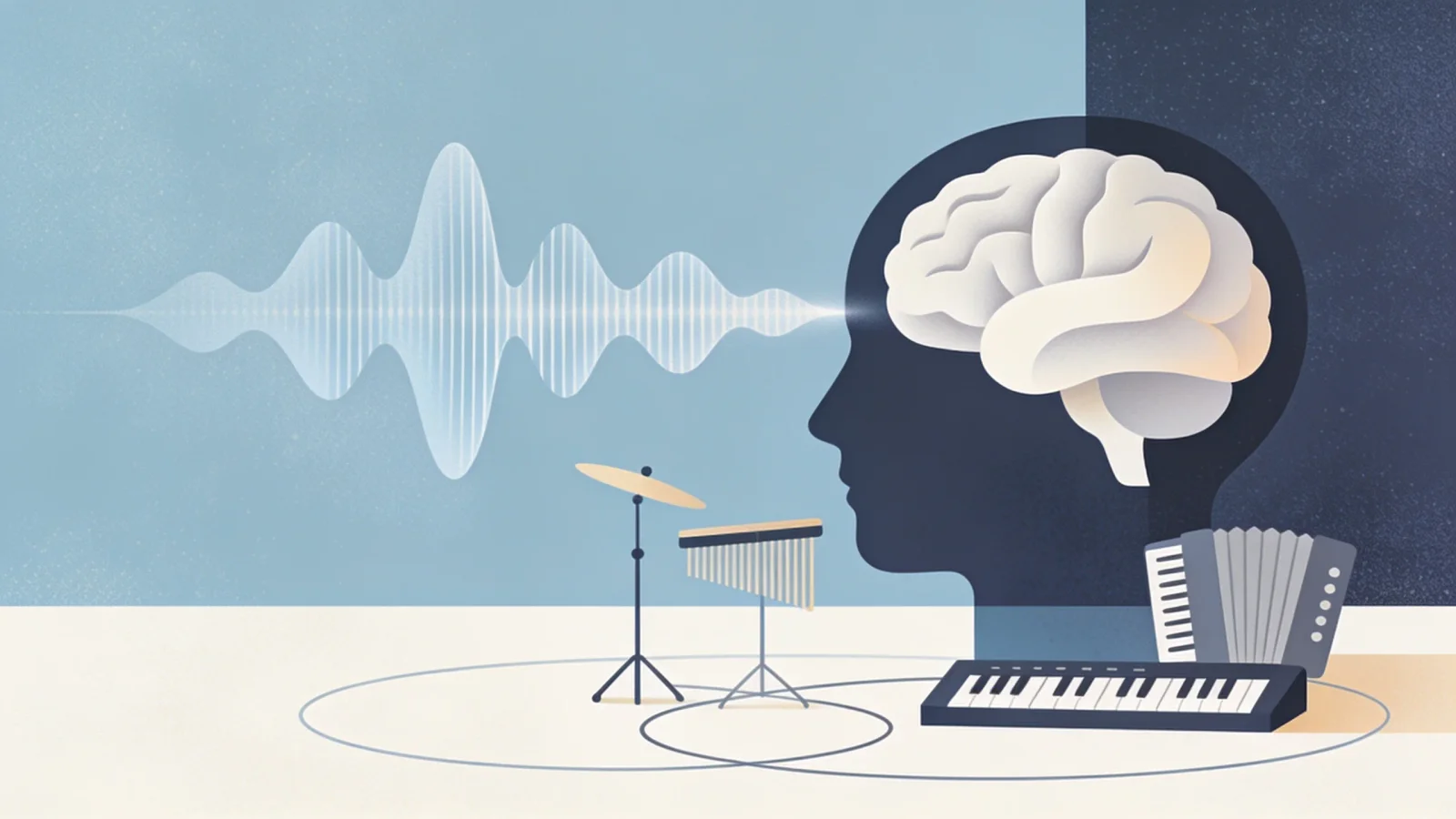
The study enrolled 16 adults in outpatient treatment for dependence on alcohol and illicit substances, including heroin, cocaine, and cannabis, through a community addiction service. Half received their routine recovery care; the other half received routine care plus six weekly music therapy sessions. The sessions were not playlists. Participants actively played — percussion, acoustic and electric guitars, drum pads, digital keyboards, production software — individually and in groups.
What the Recording Showed
Two signals stood out. Immediately after sessions, participants rated their present-moment cravings lower on a standardized Craving Thermometer than people receiving standard care alone. On the EEG side, the music group showed reduced frontal beta power, an oscillation that runs high during acute craving and cognitive-affective distress. And after baseline adjustment, the two groups differed significantly on frontal alpha asymmetry, a measure of how the brain balances approach and withdrawal motivation and positive against negative emotion.
The authors read that last finding as evidence that music-making improved the processing of negative affect — the anger, irritability, and frustration that commonly precede relapse. "The results suggest that music therapy could help people process their negative emotions, which is relevant to managing cravings and supporting motivation to change their behaviour, as well as be better able to inhibit or control their emotional responses," said senior author Jörg Fachner, professor of music, health and the brain and co-director of the institute.
What the Study Does Not Show
The headline results are narrower than the summary. In the baseline-adjusted analyses, the researchers found no significant group differences on the Brief Substance Craving Scale or on resting-state beta power z-scores at the end of the intervention; the beta reduction was descriptively larger in the music group but not statistically significant. Frontal alpha asymmetry was the one measure that separated the groups. A Go/NoGo task produced a nominal, non-significant increase in P3d amplitude — flagged by the authors as a candidate signal for future work, not a finding.
The sample was 16 people in a single pilot with no long-term follow-up, so nothing here speaks to whether music therapy prevents relapse over months. The team said it is now designing larger longitudinal trials to test exactly that.
None of that makes the study small. It is, the authors write, the first to record EEG during music therapy for substance use disorders — a first pass at turning "patients say it helps" into an electrophysiological measurement. It also supports positioning music as a complement rather than a substitute: the sessions were added to standard care, alongside the cognitive behavioral therapy and other structured interventions that carry the evidence base.
The affective-processing result is likely to interest clinicians working with dual diagnosis care, where substance use and untreated depression or anxiety reinforce each other. A low-cost, non-pharmacological intervention that measurably shifts how a person handles negative emotion would be a useful addition to that toolkit — if the larger trials confirm what a 16-person pilot saw.
Sources
Editorial Board
LADC, LCPC, CASAC
The Rainier Rehab editorial team consists of licensed addiction counselors, healthcare journalists, and recovery advocates dedicated to providing accurate, evidence-based information about substance abuse treatment and rehabilitation.
Related Articles

The Breath as Medicine: How Controlled Breathing exercises Can Reduce Drug and Alcohol Cravings
New systematic review finds controlled breathing techniques significantly reduce cravings across substance use disorders, offering accessible tool for recovery.

UCLA Study Reveals Alarming Link Between Teen Substance Use and Suicide Risk
New UCLA research finds that California adolescents using drugs or alcohol face triple the suicide risk, with nearly half experiencing serious psychological distress.

One in Nine Older Adults Who Use Cannabis Meet Criteria for a Disorder. Nobody Is Screening Them.
A UC San Diego study of 21,189 adults over 65 finds 11.4% of past-year cannabis users meet criteria for cannabis use disorder. Clinicians rarely ask.