
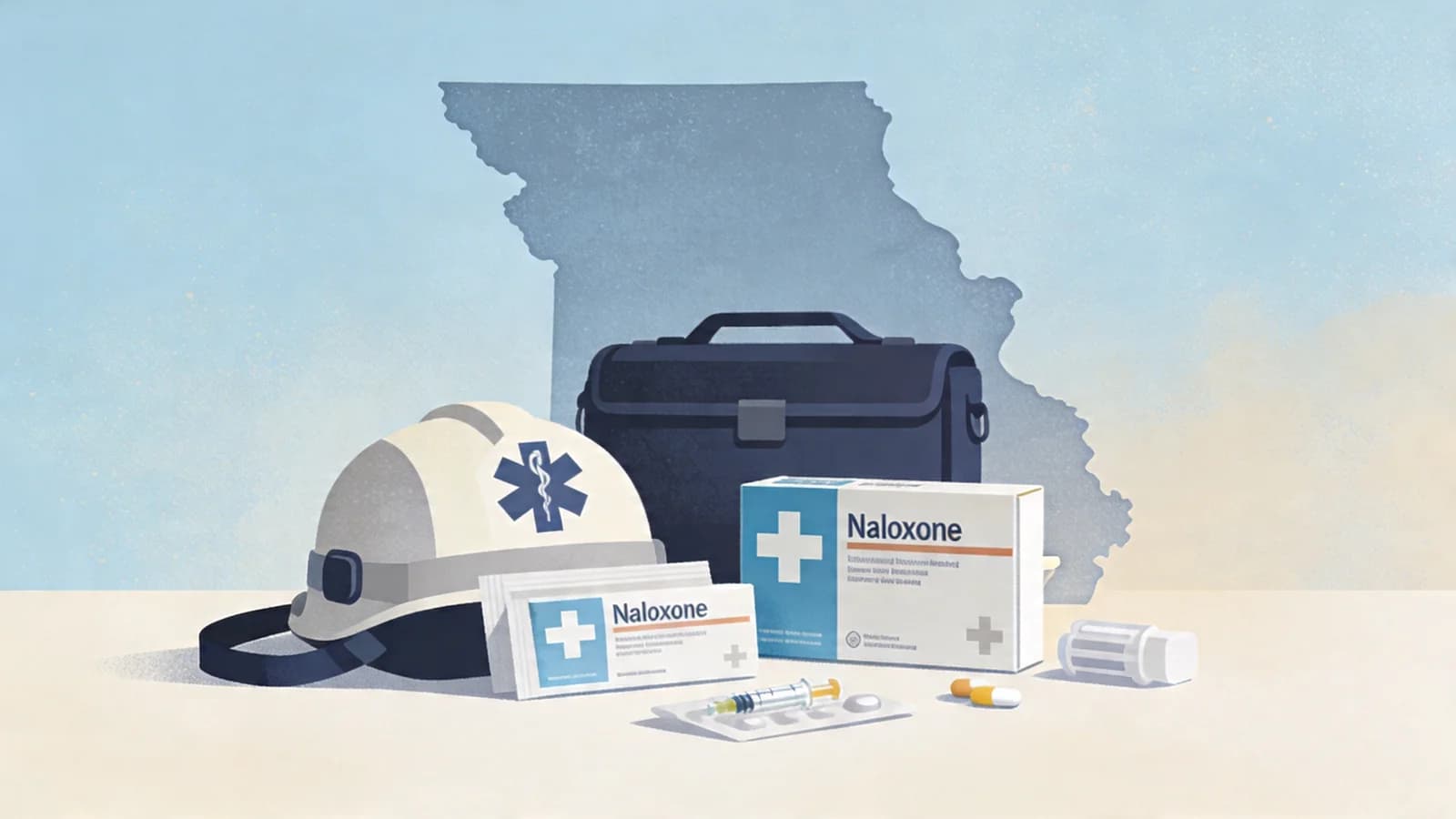
Missouri Cuts Naloxone Funding Despite 42% Overdose Drop
When paramedics from the St. Charles City Fire Department arrive at an opioid overdose scene, the patient refuses hospital transport about 75% of the time. But even when they decline further care, most accept the naloxone kits paramedics leave behind—two doses of the medication that can reverse a potentially fatal overdose, along with instructions and a list of resources for opioid addiction treatment.
This frontline distribution model, replicated across Missouri through a state-funded program at the University of Missouri-St. Louis, has distributed more than 1.2 million doses of naloxone since 2023. The results have been striking: opioid overdose deaths in Missouri fell 42% between 2021 and 2024, from a peak of 1,581 to 910. Between 2024 and 2025 alone, deaths dropped by more than a third.
Yet Missouri lawmakers are now poised to cut $3 million from the program's funding—a reduction that harm reduction advocates warn could reverse these gains just as the state is showing what sustained investment in overdose prevention can achieve.
The Budget Battle
The funding dispute began in March when the Missouri House of Representatives passed a budget that eliminated $8 million in naloxone distribution funding for first responders. The cut came during committee markup, after public hearings on Governor Mike Kehoe's budget recommendations had concluded—a timing that left many first responders feeling blindsided.
"If you know that it's not in the governor's budget, then you can react to it and say, 'Maybe not a great idea. Let's talk about that,'" said Jason White, EMS program manager for the Mid-America Regional Council. "The last-minute inclusion of those cuts left no ability to engage in the budget conversations on the House side."
Governor Kehoe had recommended keeping naloxone distribution funding flat at $13.1 million for fiscal year 2027, with $8 million allocated for first responders and $5.1 million for other distribution efforts. The House cuts zeroed out the first responder allocation entirely.
During House debate, Democratic Representative Kimberly-Ann Collins of St. Louis sponsored an amendment to restore $6.5 million for naloxone distribution. But Republican Representative Dirk Deaton of Seneca, chair of the House Budget Committee, opposed the measure. His reasoning revealed a tension at the heart of harm reduction politics: success can become an argument against continued investment.
The Saturation Argument
"I've not heard anybody across the state or any provider that they suffer from a lack of naloxone availability," Deaton said during the debate. "If anything, it's actually the opposite. I've heard reports of naloxone being discarded because it's expired."
The amendment failed 60 to 74, though 14 Republicans joined Democrats in support.
Deaton's argument—that naloxone has become sufficiently available to warrant reduced funding—echoes a broader debate playing out in states across the country as opioid settlement dollars flow in and competing priorities emerge. But first responders and public health officials say the data tells a different story.
According to the Missouri Institute for Mental Health, which manages the state's naloxone distribution, 79% of the medication distributed in fiscal year 2025 went to 563 organizations that requested routine shipments because their supply runs out. These aren't stockpiles gathering dust—they're active distribution channels serving populations at ongoing risk.
"Any meaningful restoration of naloxone funding in Missouri saves lives," said Rachel Winograd, director of addiction science at the institute. "At the same time, any cut to this funding has real consequences."
The Frontline Perspective
Marc Doll, emergency medical services bureau chief for the St. Charles City Fire Department, has watched the transformation naloxone availability has brought to his community. Around 2020, St. Charles sometimes fielded 50 overdose calls per month. Now it's rare to see more than five.
"We're going to be the ones that have the best contact time with people that are at their most vulnerable, when they're more likely to accept the help so that we can give it to them," Doll said.
The dynamic has shifted in other ways too. It's now common for bystanders or police to have administered naloxone before paramedics arrive—evidence that the medication has penetrated deeply into communities. When paramedics do arrive, they find patients who have already been rescued once, offering a critical window to connect them with longer-term care.
"Dead people don't get into long-term recovery," Doll said. "Now that we have that Narcan out there in the communities, because it's 'sitting around everywhere,' those Missourians now are not dying at the rate they were. And so the question is, do we want to protect those people or not?"
Sarah Czarnecki, mobile integrated health battalion chief for the Lincoln County Ambulance District, has seen similar results. Her county had 23 and 24 overdoses in 2022 and 2023. In 2025, that number was in the single digits.
"People are saving each other's lives," Czarnecki said.
The Senate's Partial Restoration
The Missouri Senate Appropriations Committee offered a compromise this week, recommending the restoration of $5 million in naloxone funding—drawn from the state's opioid settlement fund rather than general revenue. This would leave the program facing a $3 million reduction from current levels rather than the full $8 million cut passed by the House.
Winograd called the Senate move a "meaningful step forward" while emphasizing that even a partial cut carries risks.
The funding mechanism—using opioid settlement dollars—touches on another layer of complexity. Missouri has received $213.5 million in opioid settlement funds since 2023, money coming from lawsuits against manufacturers, distributors, and pharmacies that fueled the crisis. Republican lawmakers have increasingly sought to preserve these funds for future years rather than spend them on ongoing programs.
But Winograd argues that this is precisely what the money was intended for.
"These are not taxpayer dollars," she said. "This is big pharma money that came back to our state that we should put back into families and communities to help save and improve lives. We have a moral obligation to do that."
The Cost of Access
Even as naloxone has become more available, barriers remain—particularly cost. The FDA approved naloxone for over-the-counter use in 2023, but at roughly $50 for two doses, it's prohibitively expensive for many people who use drugs regularly.
"Their money's not going to be going there," Doll said.
This makes the free distribution model particularly important. When paramedics arrive at an overdose scene and the patient refuses transport, they don't simply leave. They talk to family members, to others who were using with the victim, leaving naloxone kits and saying, "If you change your mind, you can always call us back."
It's a harm reduction approach that meets people where they are—literally—and keeps the door open to future engagement with treatment.
What This Means for Treatment
The Missouri debate illustrates a fundamental challenge for opioid addiction treatment advocates: demonstrating that prevention spending works can paradoxically make it harder to sustain. When overdose deaths fall, the crisis feels less urgent to policymakers who never saw the emergency rooms and morgues of 2021.
But the data from Missouri's first responders suggests a different narrative. The availability of naloxone hasn't just saved lives in the moment—it's created opportunities for engagement that didn't exist before. Every overdose reversed is a potential entry point into treatment, a chance to build trust with a population that has often been betrayed by healthcare systems.
Whether Missouri's Senate will fully restore the funding, and whether the House will accept the compromise, remains uncertain. The committee recommendation must still pass the full Senate and then be reconciled with the House version in conference committee.
For now, first responders across Missouri continue their work—distributing naloxone, reversing overdoses, and hoping that the legislature doesn't dismantle a program that has demonstrated, with hard data, that harm reduction saves lives.
"I won't stop raising awareness about these lifesaving efforts until full funding is restored," Winograd said. The question is whether Missouri lawmakers will listen before the next budget cycle begins.
Sources
Editorial Board
LADC, LCPC, CASAC
The Rainier Rehab editorial team consists of licensed addiction counselors, healthcare journalists, and recovery advocates dedicated to providing accurate, evidence-based information about substance abuse treatment and rehabilitation.
Related Articles
Oklahoma Dismantles Nation's Largest Naloxone Vending Machine Program, Leaving Communities Scrambling
Oklahoma's statewide naloxone vending machine program, once the largest in the US, has been dismantled. Communities now face uncertainty as federal policy shifts and state funding gaps threaten harm reduction efforts.

Virginia Awards Record $35.2 Million in Opioid Settlement Grants to 150 Community Projects
Virginia Opioid Abatement Authority announces largest funding round to date, supporting prevention, treatment, recovery and harm reduction initiatives across the Commonwealth.

Delaware Senate Passes Harm Reduction Bill Amid Partisan Debate
Senate Bill 249 decriminalizes drug paraphernalia possession and expands sterile supply distribution, sparking disagreement over public safety and addiction treatment approaches.